Network Capacity Planning and Capex Prioritisation
Where demand will exceed capacity, and which of the candidate sites and upgrades actually earns the spend, ranked on revenue at risk rather than on utilisation alone.
Typical outcomes for this kind of engagement. Results depend on your data and starting point.
Capacity planning runs on utilisation reports and engineering judgement. Sites are upgraded because they are busy, which is not the same as being worth the money, and the plan is difficult to defend to a finance committee that wants to know what each item returns. Meanwhile congestion appears somewhere nobody modelled, because demand moved.
- Plans built from utilisation reports and engineering judgement
- Busy sites upgraded regardless of what the spend returns
- A plan that is hard to defend line by line to a finance committee
- Congestion appearing where nobody modelled, because demand moved
- No fast way to replan when the budget changes
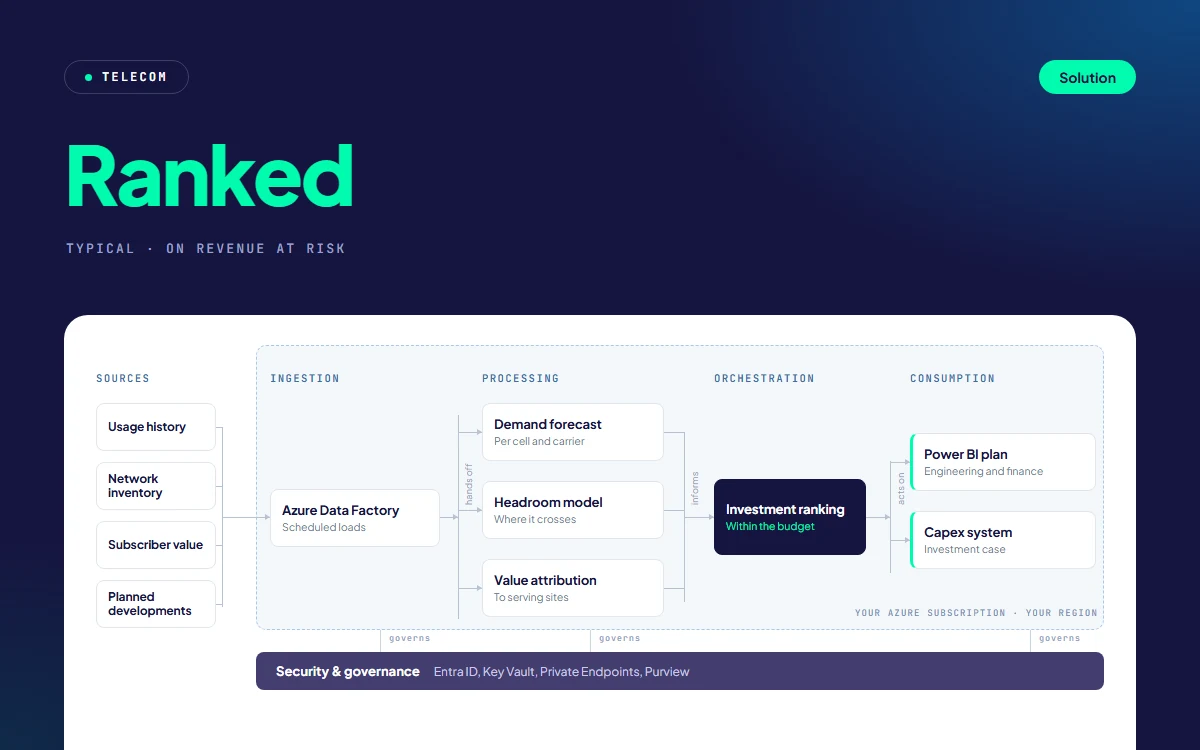
CloudGate forecasts traffic per cell and carrier from usage history, subscriber movement and device mix, and identifies where demand will cross capacity and when. Each candidate upgrade is scored on the revenue and subscribers it protects, not utilisation alone, so the plan is a ranked list with the reasoning attached — and it can be re-run when budget or demand changes.
- Traffic forecast per cell and carrier from usage, movement and device mix
- Where demand crosses capacity, and when, identified ahead of congestion
- Candidate upgrades ranked on revenue and subscribers protected
- Each item carrying the reasoning behind its position in the plan
- Replanning when budget or demand assumptions change
- One plan that engineering and finance both read