Credit Watchlist and Early Warning Memos
Deteriorating exposures surfaced from your own signals, with the watchlist memo drafted and evidenced, ready for the credit committee to argue about rather than assemble.
Typical outcomes for this kind of engagement. Results depend on your data and starting point.
Credit deterioration announces itself long before a default, in account behaviour, covenant headroom, sector news and payment patterns. Those signals sit in different systems and are reviewed on a quarterly cycle, so a name often reaches the watchlist after the position has already moved. Preparing the memo then takes a relationship manager a day of copying figures between systems.
- Warning signals split across core banking, limits, covenants and market data
- Review on a quarterly cycle, so names surface after the position has moved
- Memos assembled by hand, a day of copying figures between systems
- Each relationship manager writing to a different standard
- No consistent audit trail from a stated figure back to its source
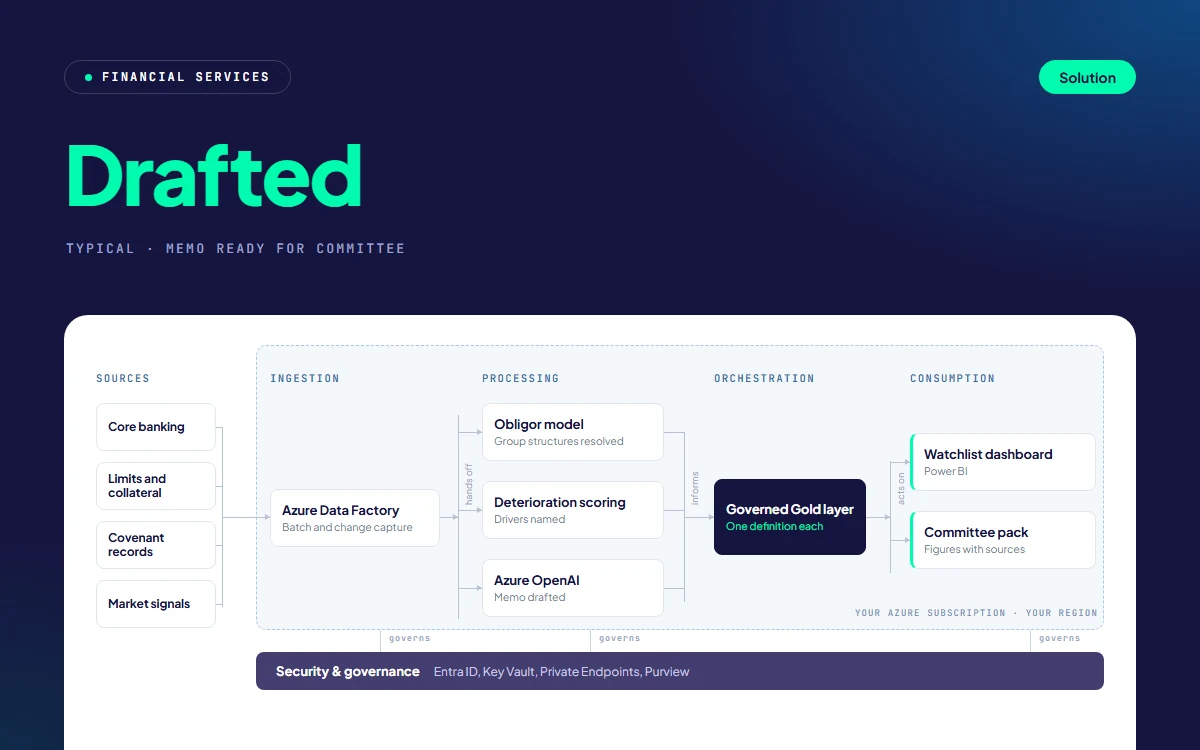
CloudGate brings core banking, limits, collateral, covenants and external signals into one governed model on Microsoft Fabric, scores each exposure for deterioration, and drafts the watchlist memo for the names that move — the position, what changed, the covenant status and the recommended action, with every figure traced to its source system. The analyst edits and signs rather than assembles.
- Core banking, limits, collateral, covenants and external signals in one model
- Deterioration scored continuously rather than at the quarterly review
- Watchlist memos drafted for the names that move, in the bank's own format
- Every figure traced back to the system it came from
- Covenant headroom and breach projections calculated, not retyped
- Committee packs assembled from the same governed numbers as the reports